
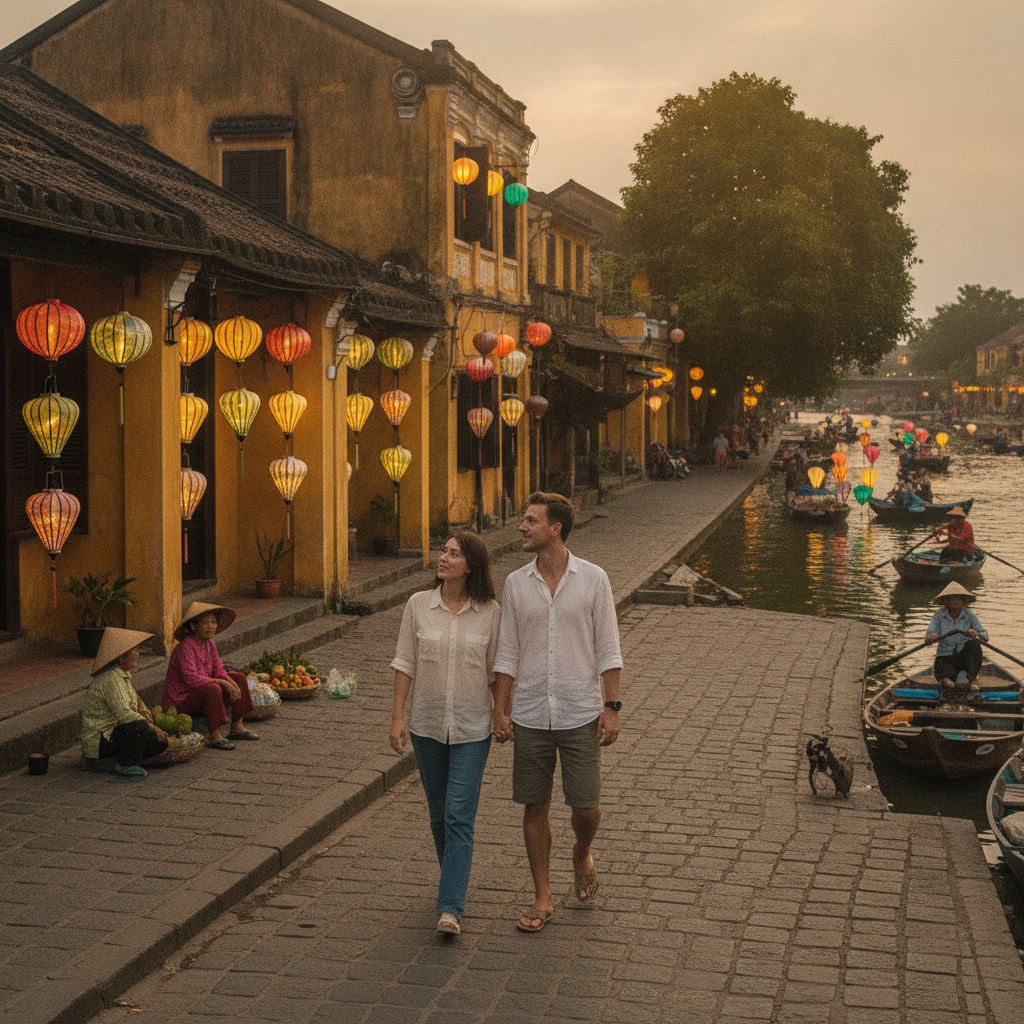
Why Centering a First-Time Vietnam Trip Around Hoi An Instead of Hanoi or Ho Chi Minh City Delivers Richer Cultural Depth at Lower Daily Costs
There is a particular kind of travel disappointment that arrives quietly — not in the moment, but days later, when the noise of a crowded city finally fades and a traveler realizes they spent a week moving fast and absorbing very little. First-time visitors to Vietnam often plan their itineraries around the country's two dominant metropolises — Hanoi in the north, Ho Chi Minh City in the south — drawn by familiarity, flight availability, and the assumption that bigger means better. What those itineraries frequently overlook is a small, lantern-lit town on the central coast that, by nearly every meaningful measure, offers a more coherent introduction to Vietnamese culture, history, and daily life — at a daily cost that often runs meaningfully lower than either major city.
The Case for Slowing Down in the Ancient Town
Hoi An's Ancient Town — a UNESCO World Heritage Site since 1999 — is not merely a preserved district within a larger city. It is, in effect, a living document of the overlapping civilizations that shaped central Vietnam across several centuries. The trading port that flourished here during the 15th through 19th centuries attracted Japanese merchants, Chinese traders, and French colonial administrators in succession, and the architectural residue of each culture remains visible in a single afternoon's walk. The Japanese Covered Bridge, built around 1590, stands at one end of the main street; Chinese assembly halls (hội quán) — communal buildings where merchant guilds once gathered for worship and commerce — anchor the interior lanes. Restoration efforts have maintained these structures without sanitizing them, and the result is a streetscape that feels inhabited rather than museumified. For a traveler encountering Vietnam for the first time, this layered legibility is genuinely rare.
The scale of the Ancient Town also matters in ways that urban itineraries rarely account for. Hanoi's Old Quarter and Ho Chi Minh City's District 1 are navigable, but they exist within sprawling, loud, traffic-saturated cities where the cultural signal is constantly competing with commercial noise. Hoi An, by contrast, is small enough to understand. A visitor can walk its primary streets in an hour, cycle to Cua Dai Beach in twenty minutes, and reach the farming village of Tra Que in the same time by bicycle. That compactness creates a quality of attention that larger cities actively work against — the sense that a place can be known, not merely witnessed.
What Daily Costs Actually Look Like
The financial case for Hoi An is less about dramatic savings and more about the quiet arithmetic of a lower baseline. Accommodation in the Ancient Town and its surrounding neighborhoods ranges from modest guesthouses — locally owned, simply furnished, often immaculate — to boutique riverside properties that would command multiples of their rate in Hanoi's Hoan Kiem district or Ho Chi Minh City's Bui Vien corridor. Street food in the central market and at the town's informal quán (small eateries) runs at prices that reflect local purchasing power rather than tourist-area inflation. Cao lầu, the region's signature noodle dish made with pork, greens, and thick wheat noodles, is available for the equivalent of a few dollars at establishments that have been serving it for decades. Bánh mì from the stalls near Bach Dang Street costs a fraction of what the same sandwich fetches in urban tourist districts. The town has a tourist economy, certainly — tailor shops, cooking class studios, lantern vendors — but that economy operates alongside, rather than in replacement of, the ordinary commercial life of a Vietnamese coastal town.
Transportation costs also compress significantly when a traveler bases in Hoi An rather than attempting a multi-city itinerary. Bicycle rental from shops along Le Loi Street costs almost nothing by the day, and the flat terrain between the Ancient Town, An Bang Beach, and Tra Que Village makes cycling genuinely practical rather than aspirational. Day trips to the imperial city of Hue — a ninety-minute bus or train ride north — and to Da Nang's Marble Mountains add historic range without requiring additional accommodation shifts. The financial logic of a base-city approach, rather than a constant-movement itinerary, applies here with particular force.
Cultural Texture That Urban Itineraries Skip
What Hoi An delivers that neither Hanoi nor Ho Chi Minh City can approximate in a standard first visit is a coherent relationship between place and craft. The town has sustained a tailoring tradition for generations, and while the concentration of tailor shops on Tran Phu Street has become somewhat overwhelming, the underlying skill is real. A garment made here in two or three days by a competent workshop — and the variation in quality between shops is significant, worth investigating before committing — represents both a practical souvenir and a legible example of the local economy at work. Cooking classes organized through venues like the Morning Glory cooking school offer structured access to regional technique: the use of rau thơm (fresh herb plates) as a condiment category rather than a garnish, the balance of fish sauce and palm sugar that defines central Vietnamese flavor, the particular preparation of white rose dumplings (bánh bao vạc) that are specific to this town and unavailable in anything resembling authentic form elsewhere in the country.
The farming and fishing communities surrounding Hoi An provide another layer of access that urban itineraries structurally exclude. The Thu Bon River, which runs along the southern edge of the Ancient Town, carries basket boats (thuyền thúng) — round, woven coracle-style vessels used for navigating shallow water — that remain in active use by local fishermen. Watching that activity from a riverside café at dawn, or joining a guided morning visit to Tra Que's organic herb gardens, produces a quality of cultural encounter that no amount of city museum-going easily replicates. The encounter is unmediated by the buffer of scale that large cities inevitably create between a visitor and the texture of actual life.
Practical Timing and the Rhythm of Arrival
The central Vietnamese coast has a climate pattern that rewards deliberate timing. The dry season between February and late July offers the most reliable weather, with February through April representing the sweet spot before heat intensifies. The town's famous lantern festival (Hội An Full Moon Festival), held on the fourteenth day of each lunar month, transforms the Ancient Town into something genuinely spectacular — electric lights are dimmed, silk lanterns are floated on the river, and the streets take on a quality that photographs inadequately and memory holds well. Arriving with that calendar in mind adds a focal point to the visit without requiring the kind of advance planning that peak-season European destinations demand.
For the traveler who finds themselves at the end of a well-spent week in Hoi An, the experience tends to circle back to a quiet realization: the richer introduction to Vietnam came not from moving through its largest cities but from staying long enough in one smaller place to understand how it worked. The lanterns are still burning at the end of the street, the tailor has delivered something that fits, and the cao lầu from the market breakfast is still faintly present as a reference point for everything that comes after. That kind of accumulated, unhurried knowing — the kind that a traveler actually carries home — is precisely what the instinct to begin in Hanoi or Ho Chi Minh City, understandable as it is, so often forecloses.