How Reading Cordless Vacuum Battery Watt-Hour Ratings Against Your Actual Floor Plan Size Prevents Overpaying for Runtime Your Home Will Never Demand
Cordless vacuum marketing leans heavily on battery runtime claims, and most shoppers walk away paying a significant premium for capacity that their actual living space will never consume. Understanding how watt-hour ratings translate to real-world cleaning time — and then measuring that against square footage — is one of the most overlooked cost-saving moves in home appliance buying. The gap between what a vacuum can do and what a home actually needs is where the overspending happens, consistently and quietly.
What Do Watt-Hour Ratings Actually Measure?
Watt-hours, abbreviated as Wh, represent the total energy a battery can deliver over time. A 25Wh battery running a motor that draws 25 watts will last approximately one hour at that power level; drop the motor demand to 12.5 watts and the runtime roughly doubles. Manufacturers like Dyson, Shark, and Bissell list watt-hour ratings on spec sheets, though they're often buried beneath marketing language about suction power and motorhead attachments. Runtime claims printed on packaging are almost always measured at the lowest suction setting, not the high-performance mode most users actually run. That gap between the advertised runtime and the real-world experience is where shopper frustration — and overspending — originates.
How Floor Plan Size Determines Your Actual Runtime Need
A compact apartment in a building like those common to Chicago's Wicker Park neighborhood might run 650 square feet of cleanable floor space. A suburban four-bedroom home might reach 2,200 square feet, but with furniture, fixed cabinetry, and room transitions, the actual vacuuming path rarely exceeds 60 to 70 percent of total square footage. The practical metric isn't total floor area — it's the continuous cleaning path between recharges. For most single-floor homes under 1,000 square feet, a 20 to 25Wh battery running at moderate suction covers the job comfortably. Buyers consistently overestimate this number when standing in a showroom, which is exactly what premium-tier positioning is designed to encourage.
Where the Watt-Hour Premium Sits in Current Product Tiers
Brands structure their cordless vacuum lines so that battery size scales alongside price, even when the jump in runtime is functionally irrelevant for the buyer's home. A mid-range Dyson V12, for example, carries a battery configuration that handles most apartments and mid-size homes without a recharge. Moving to the V15 series adds runtime capacity that primarily benefits larger multi-floor homes or users doing extended whole-house sessions in one pass. Shark's IZ and IX series follow similar tier logic. The honest question isn't which model has the most runtime — it's whether the runtime difference between tiers translates to a meaningful cleaning improvement given a specific home's actual square footage and layout complexity.
How to Calculate the Runtime You Actually Need
A rough but reliable method is to time a full cleaning pass through the home using a current vacuum or even a sweep of the floor plan mentally. Most homes under 1,500 square feet clean in 20 to 35 minutes at a reasonable pace. Adding a 20 percent buffer for edge work, furniture maneuvering, and multi-surface transitions brings the realistic target to around 40 to 45 minutes for that size range. Any cordless vacuum whose battery delivers that runtime on a mid-power setting — not the lowest — covers the home adequately. When you identify that threshold, you can filter product specs directly rather than letting marketing tier names drive the comparison.
Which Home Layouts Actually Justify High-Capacity Batteries
Not every buyer is overpaying. Multi-story homes where carrying a vacuum between floors mid-charge is genuinely inconvenient, open-plan homes exceeding 2,000 square feet, and households with heavy pet hair that require consistent high-suction settings are legitimate use cases for 40Wh and above battery configurations. Homes with significant hard floor coverage also run motors harder than carpeted spaces, consuming battery faster per square foot. The key distinction is whether the higher capacity solves a real friction point in the cleaning routine or simply provides a theoretical ceiling the home will never approach. Buyers in the first group often find the premium justified; buyers in the second group are essentially pre-paying for runtime they will never use.
How You Can Apply This Before Your Next Purchase
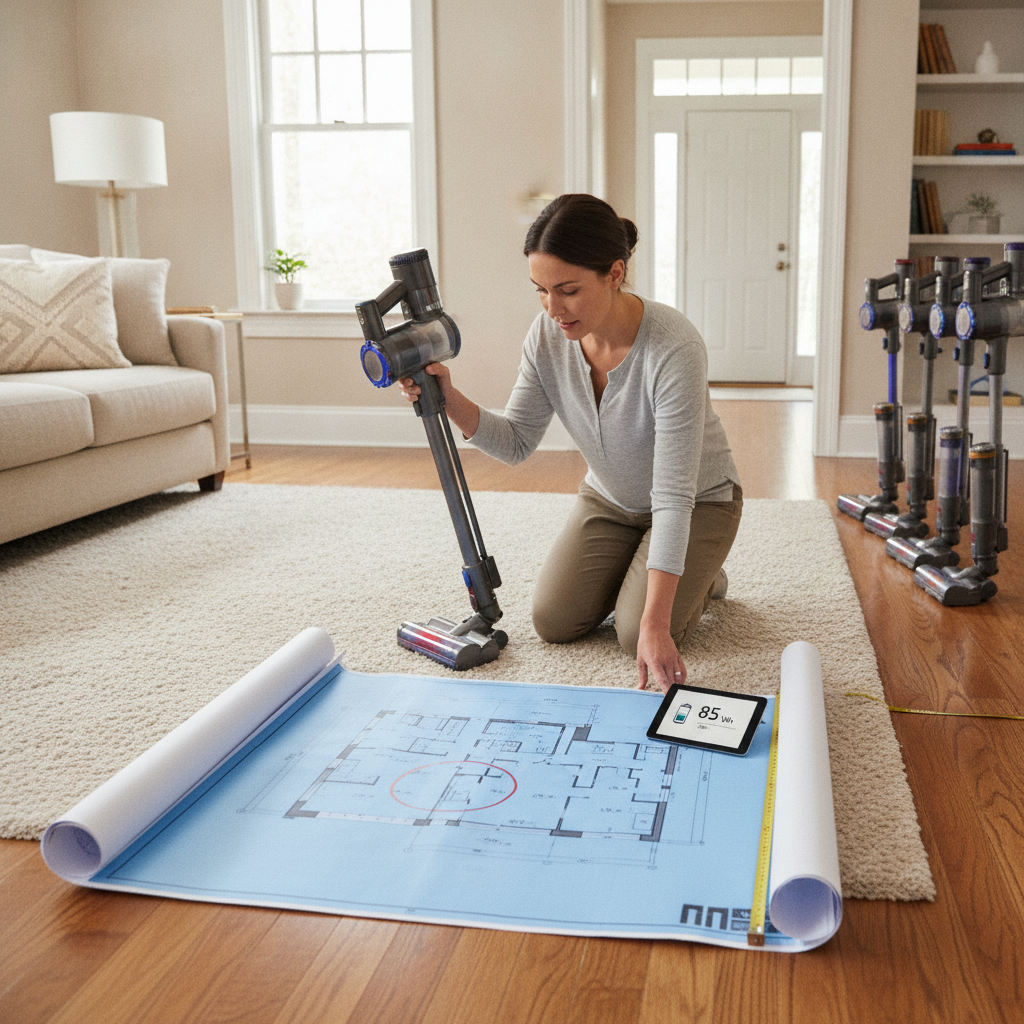
Before comparing cordless vacuum models, sketch a rough floor plan — even a simple room count with approximate square footage — and use it as your filter rather than starting with brand names or price points. Identify the longest continuous cleaning session your home demands and find the watt-hour minimum that covers it with a modest buffer. On retailer sites like Best Buy or Home Depot, filter by runtime specifications rather than suction watts, since suction numbers don't determine how long the vacuum runs. Check the spec sheet for the watt-hour figure directly; if a brand doesn't list it, ask a floor associate or look for third-party reviews that measure actual runtime at mid-power settings. Resist the pull toward the top-tier model simply because it's positioned as the flagship — the question is always whether your floor plan will ever ask the battery to prove its worth.
Matching cordless vacuum battery capacity to actual floor plan size is a straightforward exercise that most buyers skip, and the cost of skipping it compounds with every tier upgrade purchased on assumption rather than measurement. The watt-hour rating is a useful, concrete specification — but only when read against the home it's meant to serve. Grounding that number in real square footage and honest cleaning habits turns a marketing decision into a precise one, and precise decisions are almost always less expensive.