How Designing a Deliberate Weekly Analog Creative Hour Gradually Restores the Imaginative Thinking That Screen-Heavy Routines Quietly Suppress
Something shifts when nearly every waking hour passes through a screen. It's not dramatic — no single moment announces it — but over weeks and months, the mental texture changes. Ideas feel thinner. Daydreaming gets harder. The kind of loose, wandering thinking that once produced your best ideas starts to feel inaccessible, like a radio frequency you can't quite tune in anymore. If that describes your recent creative life, you're not imagining it. And the fix doesn't require a digital detox retreat or a major lifestyle overhaul. It starts with a single, protected hour each week.
Choose One Consistent Time Slot and Protect It
The analog creative hour only works if it becomes a real fixture in your week, not a floating intention you squeeze in when convenient. Pick a specific window — Saturday morning before the house wakes up, Tuesday lunch, Sunday afternoon — and treat it with the same seriousness you'd give a client call. Moleskine, Leuchtturm1917, or a simple legal pad all work fine as anchors. What matters is consistency. The brain begins to anticipate these sessions over time, and that anticipation itself starts loosening creative thinking before you even sit down.
Remove the Screen Before the Hour Begins
This step is non-negotiable. Phones face-down in another room, laptop closed, tablet out of reach. The presence of a screen — even a dark, silent one — keeps part of your attention on standby alert, waiting for something to arrive. Research into attention fragmentation consistently shows that proximity to devices affects focus even when those devices aren't actively used. Apps like Freedom or Cold Turkey can block digital access on a timer if willpower feels thin at first. The goal isn't punishment — it's creating enough genuine separation that your mind stops scanning and starts generating.
Start With Materials That Have No Right Answers
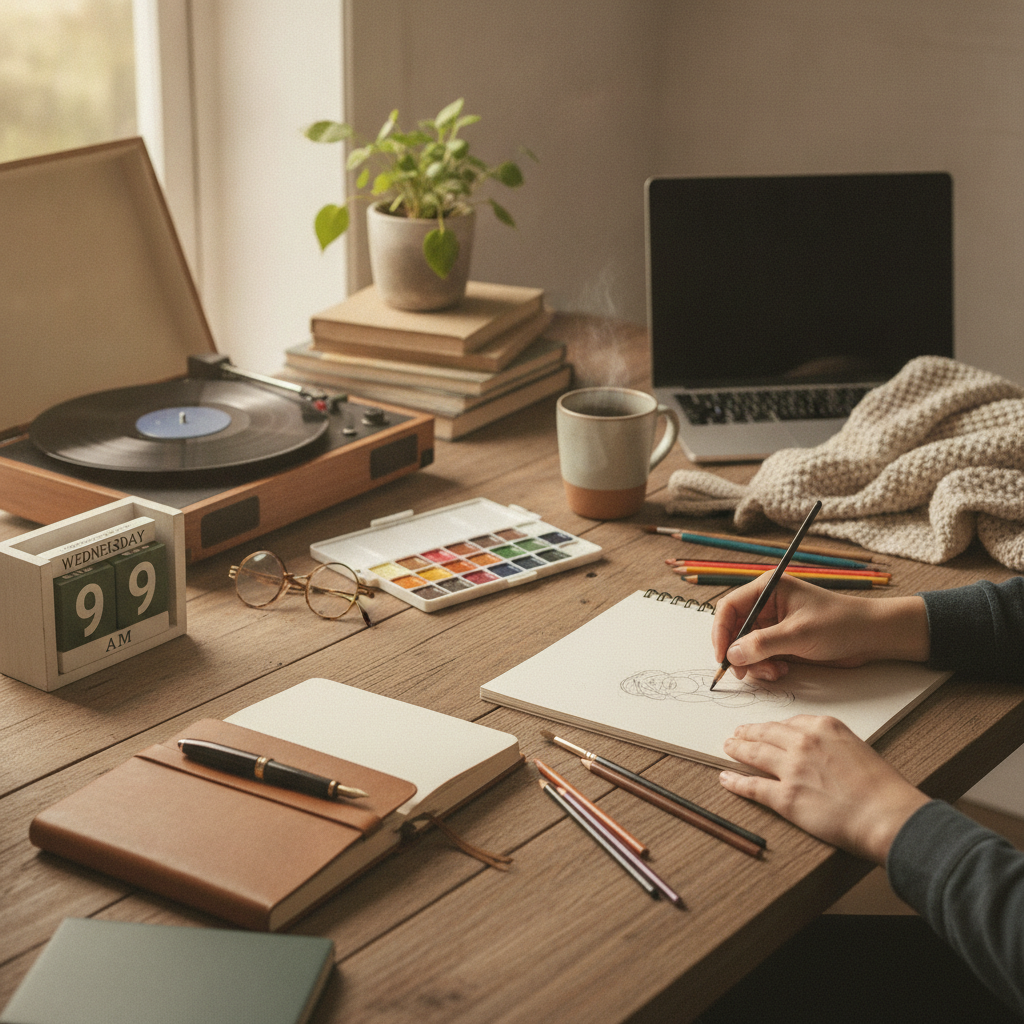
One of the reasons screen-based work suppresses imaginative thinking is that most of it is goal-directed. You're searching, responding, producing, optimizing. The analog hour needs to feel different from the start. Watercolor sets, colored pencils, a box of old magazines for collage, a jar of cheap modeling clay from a shop like Michaels — any material that doesn't have a correct outcome works. You're not producing anything for review. You're reacquainting your mind with the experience of making something without stakes, which is exactly the cognitive state where imaginative thinking re-emerges.
Give the Hour a Loose Theme, Not a Goal
A theme provides just enough structure to prevent the blank-page paralysis that kills creative sessions before they start. A goal, by contrast, reintroduces performance pressure that shuts imagination down. There's a meaningful difference between "draw something that felt heavy this week" and "finish a sketch of the backyard." Themes can be emotional, sensory, or conceptual — textures you noticed, a color that keeps appearing in your thoughts, a sound from childhood. Analog journals like the ones sold through Baron Fig encourage exactly this kind of unstructured exploration. The theme is a door, not a destination.
Build in Five Minutes of Genuine Idleness First
Before any creative material gets touched, sit quietly for five minutes without doing anything at all. No planning, no journaling, no gentle stretching — just sitting. This feels deeply uncomfortable for the first few weeks, which is exactly the point. Screen-saturated routines condition the brain to treat any gap as a prompt for input. That five-minute buffer begins to break that reflex. Over time, the brain starts using idle moments to surface connections and images on its own — which is precisely how imaginative thinking works before digital habits train it to stay passive and receptive rather than generative.
Rotate the Creative Medium Every Few Weeks
Staying with one medium too long shifts the activity from exploration toward mastery, and mastery, while valuable, isn't the goal here. The creative hour is about cognitive flexibility, not skill development. Rotating between writing by hand, sketching, working with physical textures, making simple music with an inexpensive instrument like a kalimba, or even arranging objects on a table keeps the session feeling genuinely open. Each new medium recruits different cognitive pathways, which prevents the hour from calcifying into just another routine that the brain stops engaging with after a few weeks.
Keep a Simple Log of What Surfaces
After the hour ends, spend three minutes writing a few notes — not a formal reflection, just loose observations. What came up unexpectedly? What did your mind keep returning to? What felt stuck, and what felt free? Over several months, these notes become a record of your imaginative life that most people haven't maintained since childhood. They also reveal patterns: the kinds of prompts that open your thinking, the moods that help or hinder, the ideas that keep reappearing and might deserve real attention. An app like Day One works well for this post-session note — just keep it brief and don't let the logging become another task.
Resist the Urge to Share or Evaluate What You Made
Posting a sketch to Instagram, showing your journal page to a partner, or even privately judging the quality of what you made reintroduces the evaluative pressure that the hour is designed to suspend. What gets created during the analog creative hour is for you alone, and its value is entirely internal. This matters more than it sounds. When creative output becomes socially visible — even casually — it pulls future sessions toward what worked before and what received approval. That narrowing is the opposite of what the practice is trying to restore. Let the hour be genuinely private, at least for the first several months.
The habit of reclaiming imaginative thinking through a weekly analog hour is part of a broader shift that's quietly gaining momentum — a growing recognition that screen-heavy routines create cognitive patterns that need active counterbalancing, not just rest. As that awareness deepens, more people are discovering that the creative thinking they assumed they'd simply lost was never gone. It was waiting for conditions that modern routines rarely create on their own. One protected hour a week is enough to start rebuilding those conditions — and what gradually returns tends to surprise even the most skeptical beginners.