
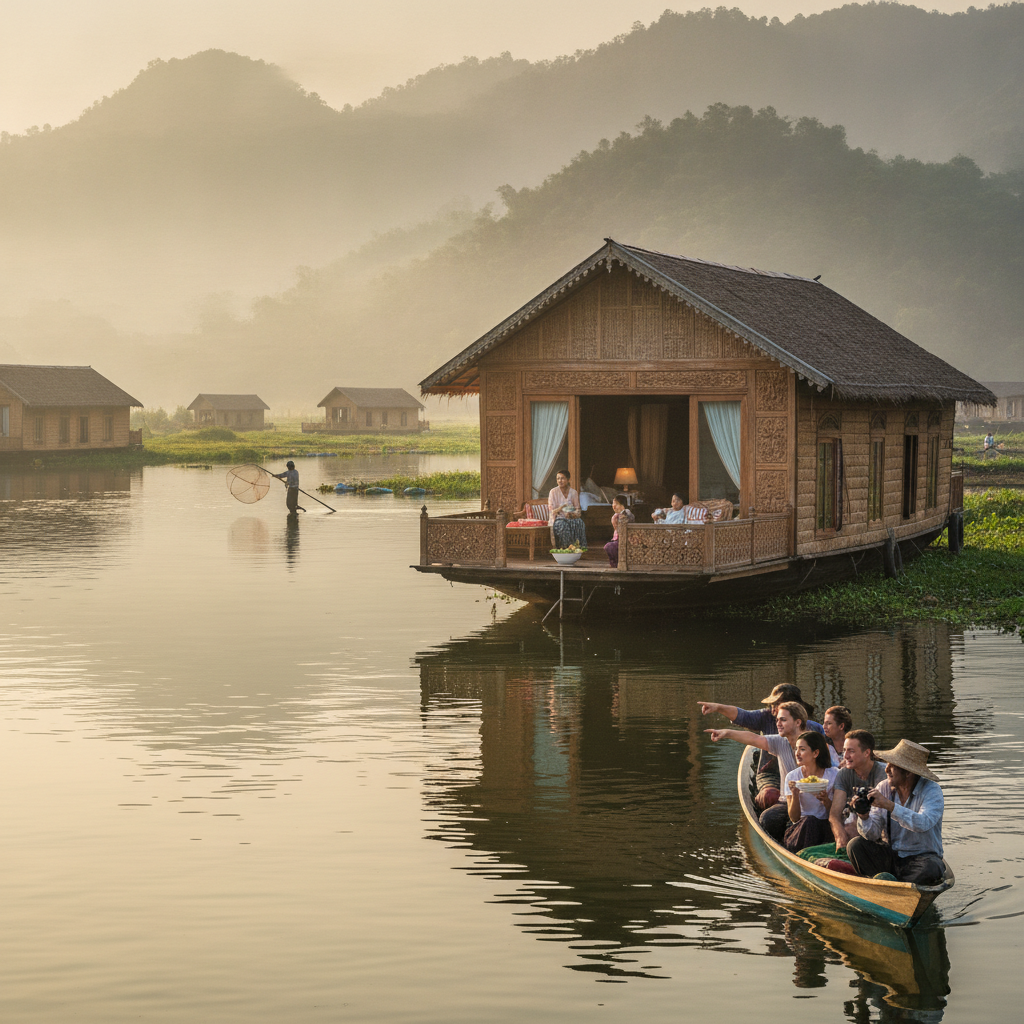
Why Booking a Houseboat Stay on Inle Lake Instead of a Yangon Hotel Delivers a More Immersive Myanmar Experience at a Comparable Nightly Rate
Travel has a way of sorting itself into two distinct categories: the kind that happens around a destination, and the kind that happens inside it. Yangon, Myanmar's sprawling commercial capital, offers the first kind with considerable polish — colonial architecture along Merchant Street, the gold-sheathed immensity of Shwedagon Pagoda catching afternoon light, rooftop bars drawing a cosmopolitan crowd. But for the traveler willing to look past the obvious, Inle Lake presents something altogether rarer: an environment where the accommodation itself becomes the cultural experience, and where a comparable nightly spend unlocks a depth of immersion that no urban hotel, however well-reviewed, can replicate.
The Economics of Sleeping on Water
The practical case deserves attention before the poetic one. A mid-range hotel in Yangon's Pabedan Township or along the riverfront corridor routinely commands rates that reflect the city's growing infrastructure and international business traffic. Inle Lake's floating and stilted guesthouses — many of them family-operated establishments clustered around Nyaungshwe, the main gateway town — occupy a surprisingly similar price band when the full accounting is done. The nightly rate at a well-maintained houseboat or over-water lodge, inclusive of the lake itself as a living backdrop, often lands within the same range as a Yangon property of comparable cleanliness and service. What changes entirely is what that money buys beyond the bed.
The comparison becomes even more favorable when ground transport and incidental costs are folded in. Yangon's density creates its own daily expenses — taxis, meals at tourist-adjacent restaurants, entrance fees to managed attractions. Inle Lake's rhythm encourages a slower pace that naturally compresses spending. A hired longtail boat (htaung seik), the narrow wooden vessels that serve as the lake's primary transport, can cover a full day of village visits and floating garden tours for a fraction of what urban sightseeing accumulates. The lake, in this sense, is not just the view — it is the itinerary.
What a City Hotel Cannot Offer by Design
Urban accommodations, regardless of their quality, are designed to insulate guests from the texture of the surrounding environment. Soundproofing, climate control, blackout curtains — these are sold as amenities, and rightly so in a city context. On Inle Lake, the houseboat or stilted lodge operates on an opposite logic. The water beneath the floorboards is audible at night. Dawn arrives through unfiltered light falling across the lake's surface, where fishermen practicing the leg-rowing technique (kyeinhsa-yama) — a Intha cultural tradition in which a single oar is controlled entirely by one leg, freeing both hands for the net — are already at work before most guests have opened their eyes. This is not something one schedules. It simply arrives, because the accommodation has placed the traveler inside the living culture rather than adjacent to it.
The Intha people (lu-myo meaning "sons of the lake") have inhabited these waters for centuries, and their relationship with the lake is architectural, agricultural, and spiritual simultaneously. The floating gardens (ywe-thoke), strips of vegetation tethered to the lake bed and cultivated for tomatoes, flowers, and herbs, are tended by the same families who operate the small workshops producing Shan-style lacquerware and lotus-fiber silk. Staying on the water places a guest within sight of all of this as daily life rather than curated demonstration.
The Cultural Weight of Stillness
Yangon moves quickly. That energy has its own appeal — the tea shop culture (lahpet yei zaing) of strong milk tea and fermented tea leaf salad consumed over rapid conversation, the street-market density of Chinatown near Latha, the layered colonial and contemporary architecture demanding attention at every block. But that pace also means that meaningful cultural exchange tends to happen in brief, incidental flashes rather than sustained observation. Inle Lake offers what might be called structured stillness — an environment slow enough that the traveler can actually watch and understand what is happening around them.
Early mornings on the lake, before the longtail boat traffic picks up, carry a particular quality of silence that recalibrates the nervous system in ways that urban travel rarely permits. The five-day rotating market (paya-san), which circulates among lakeside villages including Inn Paw Khone and Maing Thauk, draws traders from Shan, Pa-O, and Danu communities — a human confluence that has nothing to do with tourism and everything to do with the economic and social fabric of the region. Attending it from a boat moored nearby, watching the commerce and conversation unfold, is not a manufactured experience. It is simply what happens when accommodation places you in the right place at the right time.
Making the Choice That Delivers More
For anyone building a Myanmar itinerary and weighing where to spend their accommodation budget most meaningfully, the calculation ultimately comes down to what kind of memory the trip is meant to produce. Yangon rewards a day or two — the pagodas, the Circular Railway, the colonial streetscapes of the downtown grid — but it does not require extended residence to be understood. Inle Lake, by contrast, deepens with each additional morning. The light changes. The market rotates. The fishermen's routes shift. A traveler who books three or four nights on the water rather than retreating to a Yangon hotel after a single day at the lake will find that the destination keeps offering more rather than exhausting itself.
The practical steps are straightforward. Nyaungshwe is the transit hub, reachable by overnight bus from Yangon or by a short flight into Heho Airport. Accommodation options range from modest family guesthouses on stilts to more polished over-water lodges; the mid-range tier, which most independent travelers occupy, sits comfortably within the same budget envelope as a Yangon city hotel. Booking directly through established properties rather than through aggregator platforms often yields better rates and more reliable communication about boat access and local guidance.
The opening premise of any good trip is the same: where does the money actually go the furthest, in both financial and experiential terms? On Inle Lake, the answer to that question is woven into the water itself — in the floating gardens drifting at the edge of the veranda, in the leg-rowing fishermen who appear each morning as if placed there by some quiet agreement between the culture and the landscape, in the specific quality of silence that belongs only to a place where the world floats rather than stands still.