
How Reading Portable Air Conditioner BTU Ratings Against Your Room's Ceiling Height and Sun Exposure Prevents Overpaying for Cooling Capacity Your Space Will Never Need
Portable air conditioner packaging is engineered to sell the largest unit a shopper will accept, and most buyers walk away with far more cooling capacity than their room actually requires. BTU ratings — British Thermal Units — represent how much heat a unit removes per hour, and manufacturers typically advertise coverage based on idealized square footage alone. That single number hides a more complex reality. Ceiling height, window orientation, sun exposure, and even insulation quality all shift how much cooling power a space genuinely demands. Understanding these variables before purchasing is the difference between right-sized comfort and an oversized machine running at partial capacity while drawing unnecessary electricity.
Why Square Footage Alone Misleads Most Buyers
The standard BTU calculation that appears on most product listings assumes a room with eight-foot ceilings, moderate sunlight, and average insulation. Hisense, LG, and Frigidaire all publish coverage charts built on these baseline assumptions. A room measuring 400 square feet sounds straightforward until the ceiling climbs to twelve feet — at which point the actual air volume increases by fifty percent, demanding proportionally more cooling effort. Buyers who shop by square footage charts without adjusting for volume are effectively comparing apples to oranges. The chart becomes a rough starting point, not a final answer.
The Ceiling Height Multiplier That Changes Everything
Air conditioners cool air volume, not floor area. A room with ten-foot ceilings holds significantly more air than the same footprint with standard eight-foot ceilings, and every additional foot of height increases the thermal load a unit must manage. The practical adjustment is straightforward: multiply the room's square footage by the ceiling height, then divide by eight to find the adjusted equivalent square footage. A 300-square-foot bedroom with ten-foot ceilings behaves thermally like a 375-square-foot room with standard ceilings. Applying this calculation before comparing BTU ratings ensures the unit selected matches the real cooling challenge rather than a generalized floor-plan assumption.
How Direct Sun Exposure Amplifies Heat Load Beyond Room Size
South- and west-facing rooms with large windows absorb substantially more solar heat than shaded or north-facing spaces of identical dimensions. In practical terms, a sunny room can require twenty to thirty percent more cooling capacity than a comparable room without direct afternoon sun. Manufacturers like Black+Decker and Whynter acknowledge this in their sizing guides by recommending capacity upgrades for heavily sun-exposed spaces. Conversely, a well-shaded room — particularly one with blackout curtains or exterior awnings — can often perform comfortably with a unit rated slightly below the base square footage recommendation. Sun exposure is one of the most underweighted variables in portable AC shopping.
When Buying Up in BTUs Becomes a False Economy
Oversized air conditioners cool a room quickly but shut off before completing a full humidity-removal cycle, leaving the air cold but clammy. This short-cycling behavior means the unit runs in brief bursts rather than sustained operation, which actually increases energy consumption per degree of cooling achieved. For portable units specifically, oversizing also means carrying and storing a heavier machine with a larger exhaust hose footprint — practical downsides that compound the financial waste. Shoppers who correctly size their unit avoid both the upfront overspend and the ongoing inefficiency that makes a cheap-per-BTU unit expensive to operate over a full summer season.
Practical Tools for Getting the Calculation Right Before You Buy
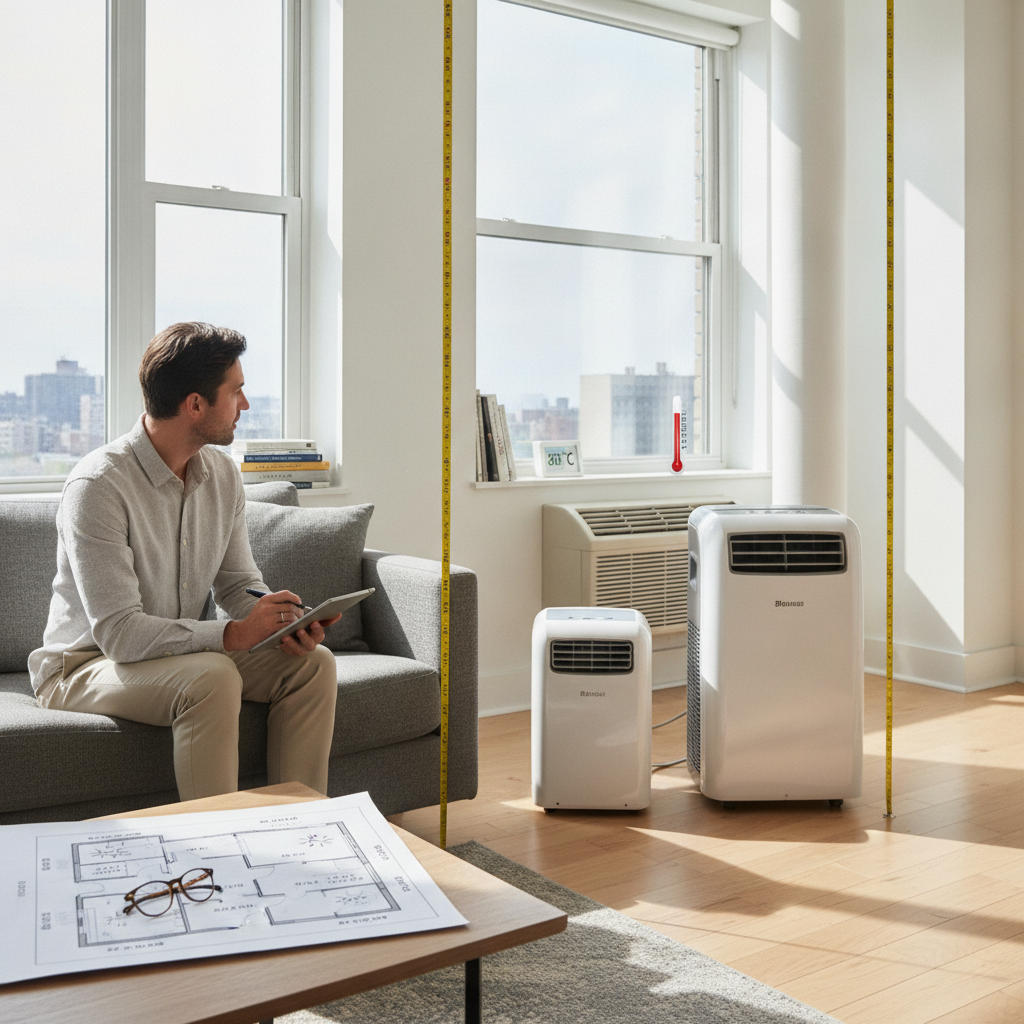
Before you head to Home Depot or browse Amazon for portable units, take three measurements: floor square footage, ceiling height, and the primary window orientation. Use those inputs to calculate adjusted air volume as described above, then apply a sun exposure modifier — add roughly ten to fifteen percent for rooms with large south- or west-facing windows, and subtract a similar margin for well-shaded rooms. Cross-reference the result against manufacturer BTU charts, and you'll have a defensible target range rather than a guess. Most households find that a correctly sized unit falls one to two capacity tiers below what packaging imagery and floor model displays suggest they need.
Matching the Right Unit to the Right Space Saves Money Twice
Buying the correctly sized portable air conditioner saves money at the point of purchase and continues saving through lower electricity costs across every cooling season. A unit that's appropriately matched to its room runs full cycles, removes humidity effectively, and operates at the efficiency level its Energy Star rating promises. Brands like Midea and De'Longhi offer well-reviewed mid-range units in the 8,000 to 10,000 BTU range that adequately serve most standard residential bedrooms and home offices when those rooms are properly measured. The savings compound quietly — a correctly sized unit purchased at the right capacity tier rather than the next size up represents meaningful value over its operational lifespan.
Portable air conditioner BTU ratings carry real meaning only when read against the full physical context of the room they're meant to cool. Square footage is a useful starting point, but ceiling height determines actual air volume, and sun exposure determines real-world heat load — both of which can push a room's effective cooling demand well above or below what a floor-plan chart suggests. Shoppers who take ten minutes to calculate adjusted air volume and account for window orientation consistently land on units that perform better, cost less upfront, and run more efficiently over time. The numbers are straightforward; the key is knowing which numbers to use.