
How Booking Coastal Portugal Towns Like Cascais and Setúbal Instead of Lisbon Cuts Accommodation Costs While Improving Daily Experiences
Lisbon has a way of pulling travelers in completely — the tiled facades, the hills, the sense that every neighborhood holds something worth discovering. But after a few nights paying premium rates for a modest room in Chiado or Alfama, the math starts to feel off. What many visitors don't realize until they've already booked is that some of the most rewarding days in the greater Lisbon region don't start in Lisbon at all. Basing yourself in a coastal town nearby can dramatically reduce what you spend on a bed while putting you closer to the kind of quiet, local rhythm that most travelers say they were actually looking for.
Understand Why Lisbon Rates Run High
Lisbon's accommodation prices have climbed steadily over the past decade as the city became one of Europe's most-visited capitals. Short-term rental saturation in the historic center, combined with strong year-round demand, means even midrange hotels in neighborhoods like Príncipe Real or Mouraria carry rates that can strain a two-week travel budget. The city simply has more visitors competing for the same central beds. Coastal towns like Cascais and Setúbal exist in a different pricing tier entirely — they attract visitors, but not at the same volume, and the accommodation market reflects that difference in ways that matter to your wallet.
Run the Numbers Before You Book Anywhere
Before committing to any base location, spend thirty minutes doing a direct price comparison across the same travel dates. Pull rates for similar property types — apartments, guesthouses, boutique hotels — in central Lisbon, then in Cascais, then in Setúbal. The gap is often significant enough to cover several meals, day trips, or a night in a pousada during the trip. Factor in that Cascais sits roughly 40 minutes from Lisbon by Comboios de Portugal train, and Setúbal is about an hour by bus or car. Neither distance is prohibitive for day trips into the capital when you want them.
Let Cascais Work as Your Base for Western Day Trips
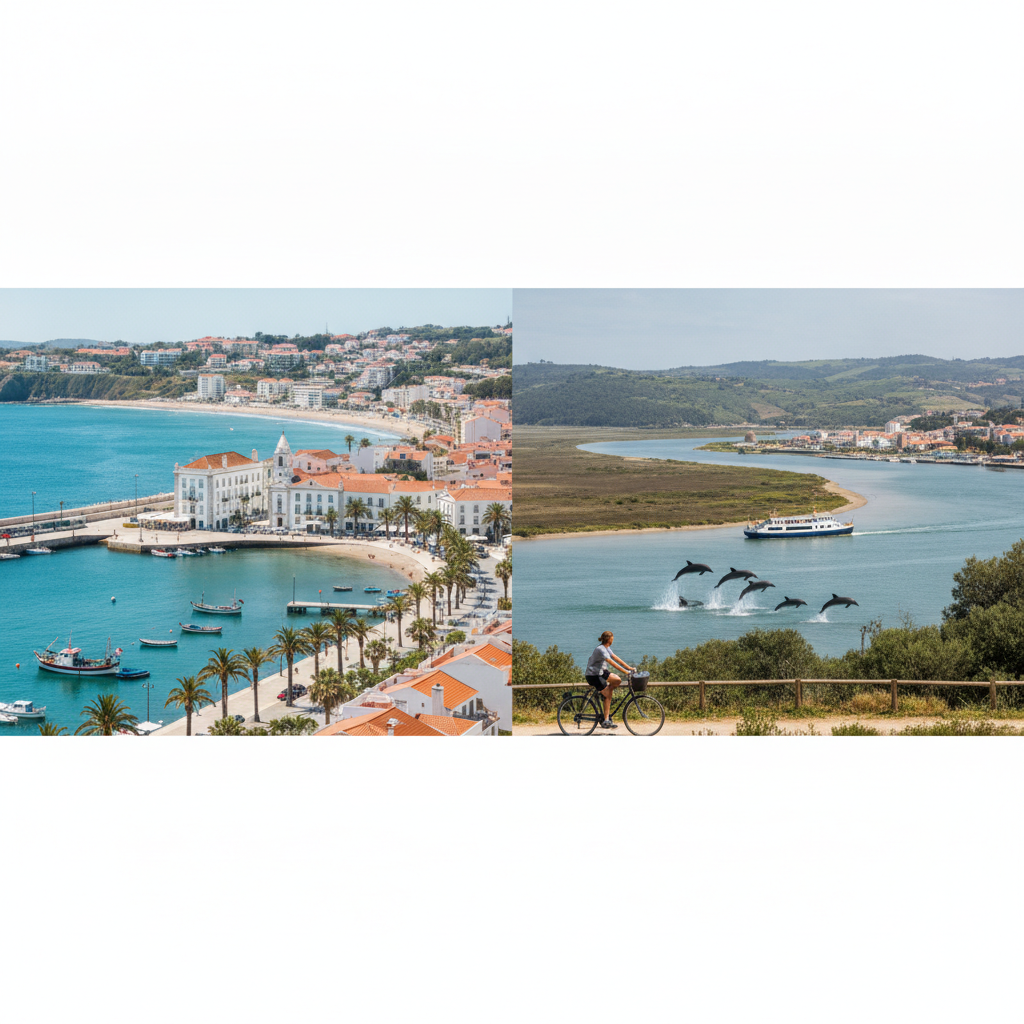
Cascais sits at the western edge of the Estoril Coast, a compact, walkable town with a genuine local economy that operates well beyond tourist season. The marina, the old quarter, and the market at Praça 5 de Outubro all have a lived-in feel that Lisbon's most-visited neighborhoods have gradually lost to souvenir shops and upscale restaurant chains. Staying in Cascais puts you within reach of Sintra, the beaches of Guincho, and Lisbon itself — all within a reasonable commute. Meanwhile, guesthouses and vacation apartments here typically run well below comparable properties in central Lisbon, with the added benefit of ocean proximity.
Use Setúbal as a Gateway to the Arrábida Coast
Setúbal is the less obvious choice, which is partly what makes it work so well. The city sits on the Sado Estuary, facing the Serra da Arrábida natural park — a stretch of limestone cliffs, hidden coves, and turquoise water that consistently surprises people who expected Portugal's coastline to begin and end with the Algarve. Accommodation here skews toward family-run guesthouses and apartments aimed at Portuguese vacationers rather than international package tourists, which tends to keep prices grounded. From Setúbal, the beaches of Portinho da Arrábida and Galapinhos are short drives away, and dolphin-watching tours on the estuary leave from the waterfront.
Book Self-Catering to Compound Your Savings
The cost advantage of coastal towns becomes even more pronounced when you book an apartment or studio with kitchen access rather than a standard hotel room. Local markets in both Cascais and Setúbal sell fresh seafood, produce, and regional products at prices that make cooking in genuinely appealing. A morning spent at the Mercado da Vila in Cascais, picking up percebes, local cheese, and crusty bread, costs a fraction of equivalent meals at a Lisbon restaurant. Self-catering doesn't mean sacrificing experience — it often enhances it, because shopping locally forces a slower, more engaged kind of travel that tours rarely replicate.
Time Your Train and Bus Connections Strategically
One concern travelers raise about basing outside Lisbon is the commute overhead. In practice, the Cascais train line from Cais do Sodré runs frequently enough that timing is rarely a burden — trains depart roughly every 30 minutes throughout the day, and the journey passes through Belém and Estoril, both worth stopping at. The Setúbal connection involves either a TST bus from Praça de Espanha or a short drive, making it slightly less seamless but still manageable for planned day trips. Building a loose itinerary around these connections — Lisbon on Monday and Thursday, Sintra on Wednesday, beaches on free days — gives structure without rigidity.
Factor in the Quality-of-Life Difference
Beyond the financial case, there's a daily texture difference that's harder to quantify but easy to feel. Returning each evening to a quieter town with a waterfront, a local pastelaria, and streets that don't fill with tour groups at 10am recalibrates the whole rhythm of a trip. Travelers who've made this switch often report that the slower pace of coastal towns feels more restorative than another night in a city that never quite stops. That recovery time — the morning coffee without noise, the evening walk by the water — tends to make daytime excursions feel like choices rather than obligations.
Watch for Shoulder Season Rate Drops in Both Towns
Spring and autumn represent the clearest opportunity to stack the cost advantage even further. Both Cascais and Setúbal see their lowest accommodation rates in March, April, October, and November, when Portuguese coastal tourism slows but the weather remains genuinely pleasant. Lisbon, by contrast, draws visitors year-round and maintains higher rates even in the off-peak window. Booking a two-week stay in a coastal town during shoulder season — locking in an apartment a month or two in advance — can yield accommodation costs that make a longer trip financially viable where a Lisbon-centric itinerary might not be.
The broader pattern here points toward something that experienced travelers have long recognized: proximity to a famous destination doesn't require sleeping inside it. As remote work makes extended travel more common and more people plan trips of two to four weeks rather than long weekends, the calculus around base location is shifting. Coastal towns like Cascais and Setúbal are positioned to absorb more of that demand — which makes now a particularly good moment to book before the pricing gap narrows.